

Practitioners of Freedom
The impulse to resist dominant culture or common practice is something that comes naturally to skateboarders. We see public spaces beyond the confines of their typically accepted use: ledges, stairs, banks, walls, empty plazas, car parks, handrails. This is a form of complex spatial imagining: the capacity to look at things from different perspectives, to be critical of accepted spatial practice, and to find possibilities where others see only function, order, or restriction.
Images and video have always been central to skateboarding culture because skateboarding itself is otherwise ephemeral: a physical practice that often takes place in edgelands, secluded corners, secret spots, or at times of day when few people are watching. Without visual media, a hard-fought trick executed on a street obstacle would merely exist as a fading memory; photography and video transform an unrepeatable physical act into lasting cultural proof. The most iconic images are not always those that show extreme virtuosity, feats of scale, physical mastery, or extreme gnar. They are often images that capture skateboarding at a moment in time that intersects with social and political currents happening within mainstream culture, and these images aim not merely to gather attention, but to generate social and political change (Willing & Pappalardo, 2023).1 As such, they also support self-representation in the context of social and political change and confirm a subcultural mindset and physical attunement to space and to time.
In the 1970s and 80s, this resistant sensibility was most iconically conveyed through Craig Stecyk’s documentation of Dogtown skateboarders. His images of non-conformist skaters such as Tony Alva and Jay Adams presented skateboarding as a symbol of resistance to dominant, middle-class American culture, even if that image also carried the exclusions of its time: a disdain for other skateboarding practices and an erasure of the wider contribution of women and other skaters outside the dominant narrative.
In recent years, some of the most significant skateboarding images have been those that represent skaters whose lived experience moves outside dominant narratives about who typically rides a skateboard. Photographs and videos of women, non-binary skaters, trans skaters, LGBTQI+ skaters, and global majority skaters assert our existence against the traditionally hetero-masculine, Western imperialist, and white-dominated form of skateboarding culture. See for example, the extensive content of the non-traditional skate magazine, Skateism (2015-2023); Melkweg Amsterdam’s exhibition on SK8 Girls (2026); Cindy Whitehead’s book It’s Not About Pretty (2017); or Skate Girls of Kabul (2015) by Jessica Fulford-Dobson–a book that documents Skateistan’s2 sessions with young girls in Afghanistan. These are a small selection of examples, amongst hundreds of others. Social media has expanded this field further, allowing groups outside the commercial or mainstream skateboarding world to platform their practice on their own terms, and to put forward their own viewpoints to a global audience.
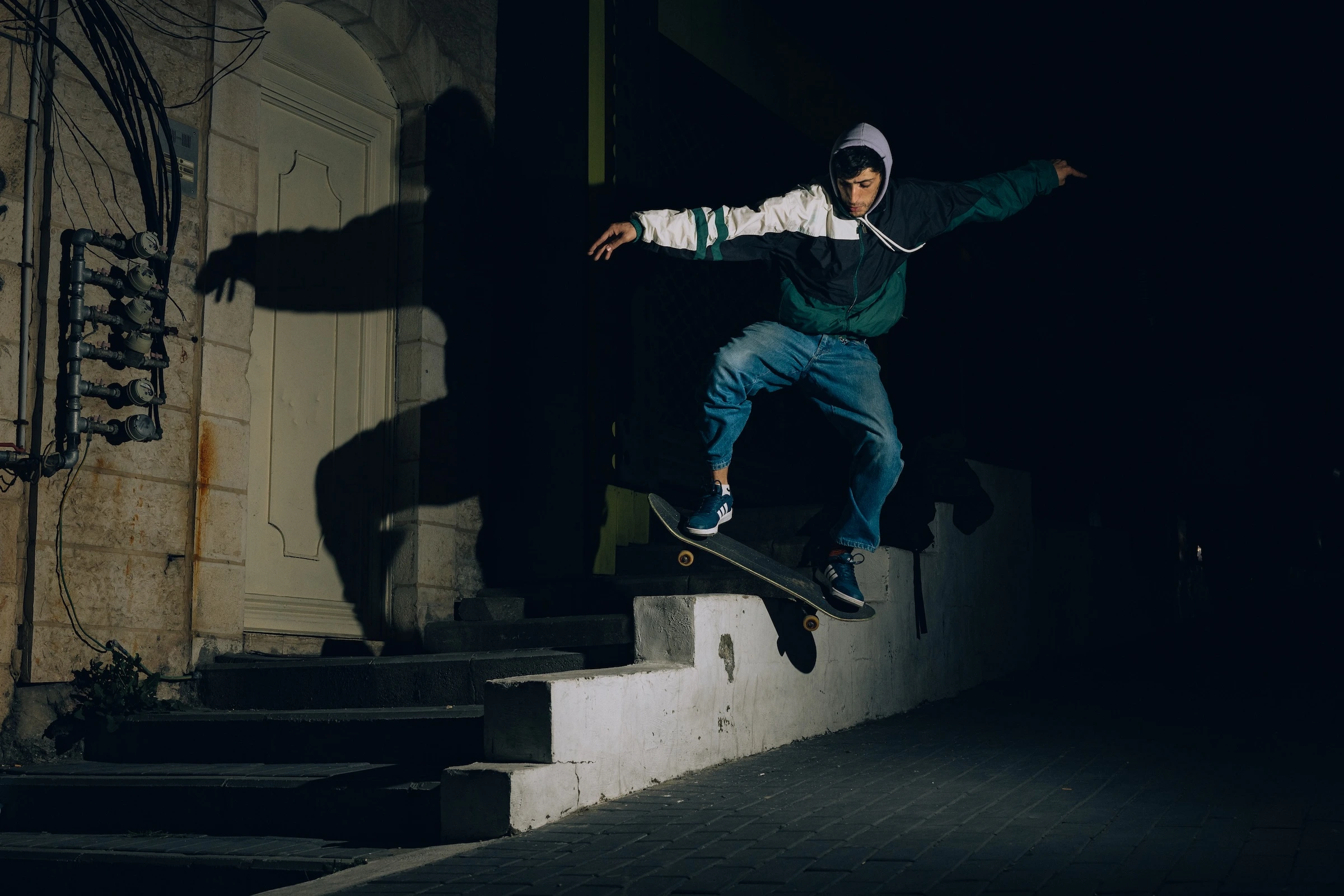
Whereas in the 1980s and 90s, skaters produced their own zines and distributed them locally, nationally, and maybe to small communities overseas, social media has exploded the possibilities for us to witness the practices of skaters whose lives are much different to our own, who live in parts of the world we may never have visited or known about. These platforms are not universally accessible, and access remains uneven across class, region, gender, infrastructure, and affordability, but they have changed who can be seen, who can speak, and whose skateboarding cultures can circulate internationally.
This article focuses on the resistant photographic and filmic content being produced by and with skateboarders in Palestine. Palestinians continue to live, love, hope, and skate against the persistent violence of Israel’s settler-colonial project: a project that intensified in 1948 with the Nakba, the catastrophe of Palestinian displacement, dispossession and death, and that continues through occupation, apartheid, siege, and genocide. At a time of intensified colonial violence across the occupied territories since October 2023, it feels important to attend to the ways Palestinian skateboarders, artists, and their allies use images not only to document skateboarding, but to insist on life, agency, political insight, intimacy, and freedom.
Palestinian resistance conveyed through the lens is dealing with multiple forms of oppression and flattening: not only the material violence of occupation, but also the representation of Palestinians and Arabs in Western-centred media as culturally backwards, terrorist, or inherently violent. In many cases, representations of Palestinians simply do not exist at all. Palestinian organisations and artists use photographs and video to counter reductive portrayals, and to present Palestinian culture in its richness: to show us in the fullness of our human experience.
Here, I elaborate on one specific case study: the skateboarding communities of Palestine, and the visual documentation of contemporary Palestinian skateboarding through professional video making, artistic representation, and grassroots social media images.

Epicly Palestine’d and Palestinian skateboarding in skate films
The film Epicly Palestine’d: The Birth of Skateboarding in the West Bank, made by Theo Krish and Philip Joa, two skateboarders from the UK, premiered in 2016. Krish is one of the directors of SkatePal, a charity whose early formation the film documents. The film presents the development of a skateboarding scene in Palestine through the perspective of Charlie Davis, a skateboarder from Scotland who was teaching English in the West Bank in 2013. Davis began entertaining local children with his skateboard, then came up with the idea to build ramps, bring over equipment and teach them how to skate. Through this process, he came to know the small group of Palestinian skateboarders who were practising at that time. This small group, unable to travel out of Palestine and to connect with skateboarders in other parts of the world, were primarily learning about tricks through YouTube videos, and relying on equipment to be brought from other countries by visiting family and friends.
Epicly Palestine’d presents the first wave of Palestinian skateboarders to an international audience, and does so against the backdrop of lives and livelihoods deeply impacted by the Israeli occupation. The film introduces Palestinian skateboarders not as victims of war, nor through racist tropes of violent religiosity, but as people living, playing, working, and striving for the same things that most people in the world want: to live in freedom, and to be able to expand the body and the mind’s capacity.
Early in the film, we are introduced to Abdullah and Eihab, two skaters from Qalqilya in the north of the West Bank. The image presented of Qalqilya is one of enclosure and stagnation. We see a static funfair: the rides quiet and unmoving, play equipment covered in layers of dust. Then follows footage of a zoo, with animals in cages, but no visitors.
The zoo is still in operation, but it is a site of lost childhood and of sorrow, as much as it provides moments of relief and normalcy to children and adults in the West Bank. During the second intifada, a child was shot dead outside the entrance; the zoo’s male giraffe was startled by gunfire and ran into a pole, leading to its death; the giraffe’s mate subsequently miscarried; and the zoo’s entire collection of zebras were teargassed to death. None of these details are given, of course, in Epicly Palestine’d, but the image of the empty zoo and the worn-out play areas signifies the extent to which animals and children suffer and are killed as a result of the occupation.

Next to the zoo, behind a locked gate, the skateboarders in Qalqilya have a small segment of joy: their own professionally built mini ramp, where in stark contrast to the environment around them, they skate and perform parkour. Skateboarding is presented in Epicly Palestine’d as a direct counter to the effects of the occupation, as a relief. Eihab rolls up the transition of the ramp, close-up, in slow motion. We see his feet leave the board completely, and then we see him forward-flip onto the platform. His blending of skateboarding and parkour can be read as an expression of his desire for movement that breaks free from the confines of established modes of being and behaving.
We also see one of the skateboarders, Aram Sabbah, attend a protest against the occupation at Qalandia checkpoint, where he is shot in the leg by an Israeli sniper. The first thing he worries about is whether he will skate again, and we follow his rehabilitation on screen. Besides the occupation, Palestinian social expectations and traditions also have a restrictive effect on young people, something expressed by Eihab and Abdullah in the film. This matters because the film does not reduce Palestinian life to occupation alone; it shows people negotiating several forms of pressure while seeking freedom through movement, friendship, and play.
The film then moves to Ramallah, a bustling, vibrant city. Local people watch the skateboarding in the central plaza. Amr explains that there are no easy ways for skateboarders to get equipment. They are sharing boards, skating with broken boards, and having to weigh up the risks of trying a trick and snapping a deck.

The title Epicly Palestine’d references the skateboarding documentary series Epicly Later’d, which was popular at the time the film was made. Created by Patrick O’Dell, the series documented New York skateboarders through a photo-diary format. The reference codes Epicly Palestine’d as knowledgeable of, respectful of, and aligned to dominant Western skate culture. It also positions the documentary as speaking directly to skateboarders: it is about bringing the dominant culture’s attention to an otherwise hidden or overlooked skateboarding scene.
Since the film was created, the Isle Skateboards team visited Palestine and created a short edit titled Pieces of Palestine, which integrates local skateboarders with Isle’s professional team in a way that shows the company’s respect for the extant skate scene. The film also documents snippets of life in Palestine: people, food, the separation wall. More recently, Thrasher3 published Wellspring: Ryan Lay in Palestine, an edit of US professional skateboarder Ryan Lay, who is also an ambassador for SkatePal.
Whilst Epicly Palestine’d explicitly addresses the occupation, Pieces of Palestine offers a more subtle presentation of architectures of oppression, such as people skateboarding by the separation wall itself. Thrasher’s Wellspring lends support to the charity and highlights the skateboarding scene through what is probably the most globally recognised skate media brand, but it does not picture or discuss the occupation at all. The absence is not neutral. It shows how mainstream skate media can celebrate Palestinian skateboarding whilst leaving the political conditions unnamed.

International platforms are, of course, likely to be more risk averse editorially, but this absence also points to the lack of political engagement endemic to mainstream skateboarding discourse. Historically and, somewhat ironically, skateboarding culture is surprisingly conformist in discouraging critical political viewpoints that either divert attention away from the physical act of skateboarding—shut up and skate!—or that paint respected figures in a bad light. Being able to adopt this kind of apolitical position always comes from a place of privilege and a lack of skin in the game.
In this sense, Epicly Palestine’d represents a contribution to skateboarding culture that resists the depoliticising of life, while it broadens skateboarders’ awareness of the situation in Palestine, and refuses mainstream media’s flattening of representations of Palestinians and Arabs.
Exist
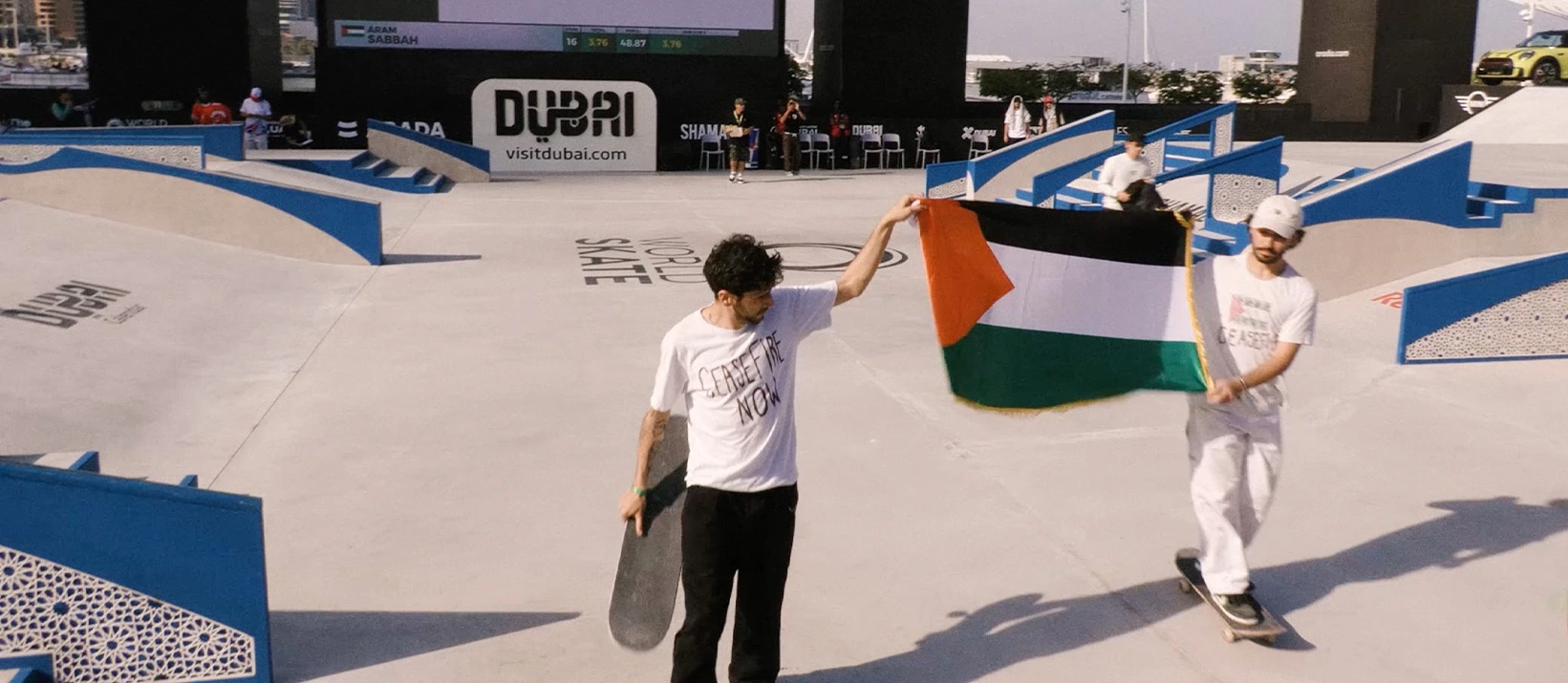
In 2025, ten years after the creation of Epicly Palestine’d, Markus Bengtsson and Viktor Telegin premiered their documentary Exist, which follows the now much older Palestinian skateboarder we met in Epicly Palestine’d, Aram Sabbah, as he participates in the Olympic qualifiers for skateboarding in Dubai in 2024. Aram is now the local manager for SkatePal. The film documents his training in Sweden, his personal relationships, and his feelings of grief at competing while Palestinians in Gaza are being killed.
We learn throughout how Aram wrestles with his emotions while he is training. We recognise that he is dealing with circumstances that are much more challenging than most, if not all, of the other athletes competing in Olympic skateboarding. This is not simply a documentary about Aram’s world-class skateboarding ability. It is about him wanting to represent Palestine on a global stage, to say: “we are here”, “we exist”. Aram’s participation is an act of resistance to Israeli colonial erasure.
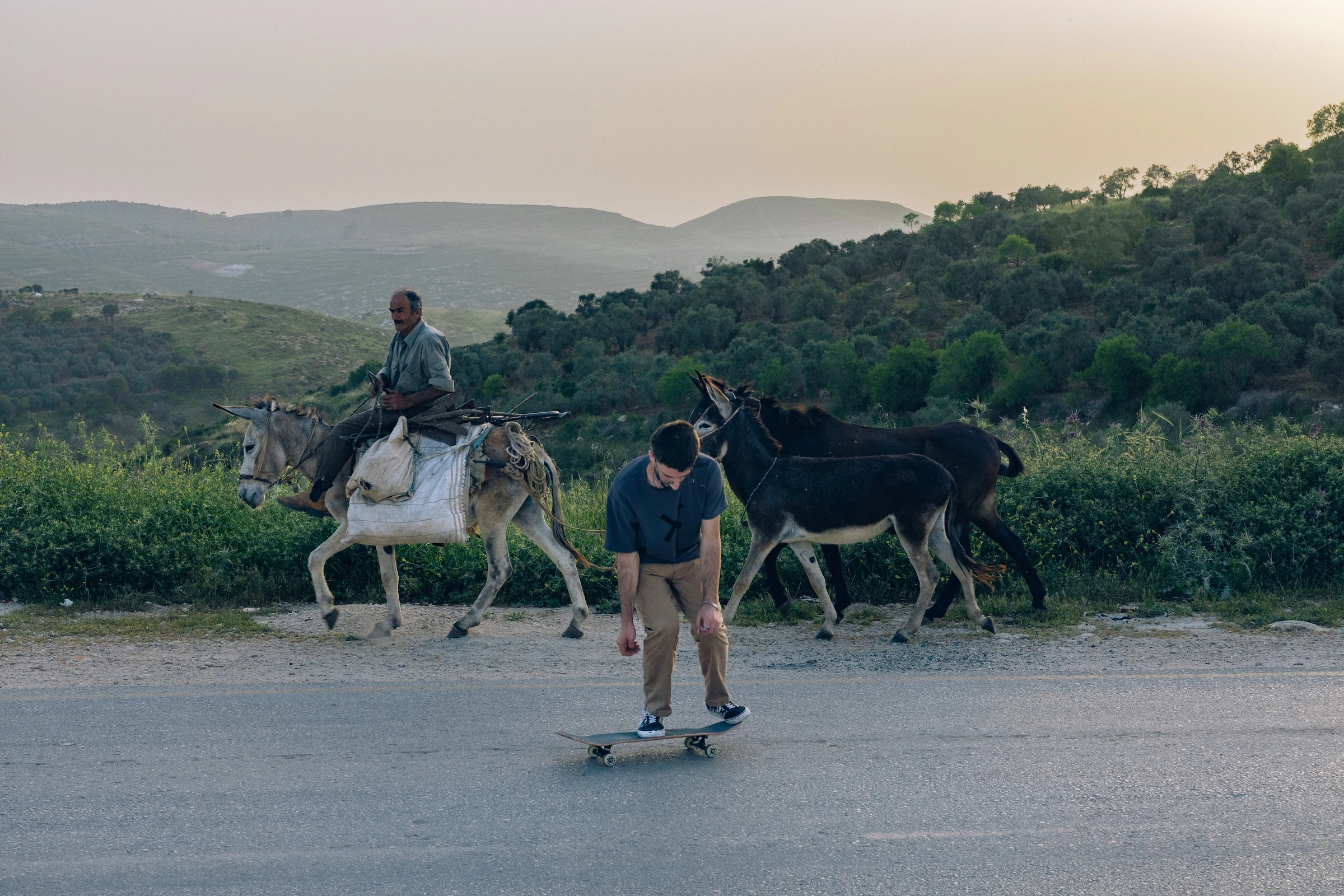
The journey of these films can be seen, on the surface, as a linear trajectory: a young teenage Palestinian skateboarder progresses to represent his country in the Olympics. But this narrative only tells half the story. The other journey is a cyclical one, of restriction and violence, which repeats throughout each film, never ending.
Maen Hammad — Landing
These journeys are elaborated further in artist Maen Hammad’s book Landing, a visual diary that documents Hammad’s return to Palestine from the US, and his love for skateboarding and the communities he lives within.
We see images of enclosure and restriction, such as the curve of Israel’s separation wall bending back on itself and enclosing a mound of wildflowers and grasses, a residential block of flats in the background. In another image, a tired, hot horse stands with its nose touching the separation wall. It reads as if the horse is weary—not just of the heat, but of the wider circumstances of life, which put walls in front of it, in front of us.
But these types of images are cut through, interrupted by something more powerful: love, friendship, joy, and the magic of what an image can convey about these simple things. Evening sunlight strikes through the open door of a building. Inside, a skateboarder framed within the beam ollies a three-set, heading in the direction of that open door. That outside space. The rest of the building in darkness.
This is part of a thread of portals that can be seen across Hammad’s images. In the chapter ‘Medium-Distance Relationship’, Hammad refers to holes in the separation wall or fence as portals because they circumvent the restrictions imposed by the Israeli state. They are literally holes in the colonial fabric. Magic.
In another image, Aram—the same Aram we know from Epicly Palestine’d and Exist—is pictured defying gravity, wallying the base of a tree. As Hammad writes, “it was not until middle school that skateboarding’s cryptic superpower revealed itself to me…the space around me became a skatepark…an entirely new lens on the world; magic”. And in another, a young boy is pictured upside down on a football goal post. The image is sideways. We must turn our heads, or the book, to see it. Children know magic.
Love is a major theme across Landing. The images and words Hammad presents of intimacy are a rare perspective that we, the readers, are taken by the hand to meet. Hammad’s image of Kilani photographed from behind, as he moves through a hole—or portal—in the fence, positions the reader as a confidant. We are with Kilani, coming along for the journey from the West Bank to 48 Palestine as he goes to meet his love, Tala. There is something about this viewpoint that makes my heart beat faster: I am conscious of how dangerous this crossing is, and I feel like I am there.
A few pages later, our perspective shifts to float above the couple as they embrace on the ground, on a patch of grass, somewhere in 48 Palestine, somewhere near a skatepark. Hammad’s accompanying words provide a contextual map for the crossing, the meeting of lovers, and the return, which deepens the meaning of these images. These are not simple photographs of a skate trip and a meeting. They are documentation of people attempting to live ordinary lives, made deadly by the circumstances of Israeli colonial violence.
Hammad’s pairings of images are particularly arresting when read together. In one section we are presented with an image of a protest that has turned violent. A young Palestinian man wrapped in a Palestinian flag moves through a street that is on fire; smoke plumes rise and detritus is scattered across the ground. It is night-time, and ahead of him are three other men walking calmly, one of them wearing a press vest. The next image is of Aram, also photographed at night, performing a boardslide on a flat wall. His arms are outstretched, his knees spread open across the width of the board.
The images show different forms of resistance to the occupation. Aram’s image represents freedom of expression, of his body, in a context where Palestinian bodies are controlled: made to walk through checkpoint architectures that resemble cattle pens, forced to move or stop, to remove clothing, to be indoors by 10pm, to sit in the baking sun for hours while IDs are checked, or to be forced into stress positions during detention.
Landing also contains several personal stories, including an interview transcript that Hammad conducted with his Baba. In this passage, Hammad’s Baba describes his experience of being held in an Israeli prison in the 1970s. It is a harrowing account of Israeli violence, underpinned with the indignant sumud of the Palestinian hostages held in Israeli prisons who taught each other decolonial theory and organised strikes, despite the ramifications from the Israeli Defense Forces.
Sumud is an essential Palestinian cultural value, ideology, and strategy of perseverance and everyday resistance. It represents the collective determination to remain on the land, maintain dignity, and defy erasure in the face of ongoing oppression. It extends beyond survival: it is a refusal to leave one’s home, heritage, and community. In Landing, this comes through most poignantly when Hammad’s Baba describes how his mother would walk to the prison and sit underneath a tree outside, just to be near her son. She would sit there and sing, and cry. And Hammad’s Baba would shout to her: “Do not worry, I am a Mountain”.
There is something else that comes through these images. The idea of landing, not so much as in landing a trick, succeeding, and rolling away, but rather in the idea of continually making the land. This speaks much more deeply both to Hammad’s return to his country, and to the constant job of existence, of remaining, of being on the land. This meaning of land-ing keeps appearing in Hammad’s images: the presence of skateboarders in Palestine riding the land, living, and returning to that land again and again.
Gaza Skate Team
Besides these visual documentations from photographic art and filmmaking, many Palestinian skaters use social media themselves to communicate with the world. One of the most striking examples in recent years is the Instagram account of the Gaza Skate Team.
Many of the images and videos posted, featuring skateboarders of all ages in Gaza, are of tricks performed on rubble or within the remains of bombed-out buildings. In one video, posted on 11 May 2025, the head of the Gaza Skate Team, Rajaab Al-Reefi, performs an ollie on the remains of a huge rocket shell lying empty amidst the rubble of buildings.
Other videos show scores of happy children learning to skate in sessions organised by Rajaab in empty playgrounds and sports areas. The feed is punctuated by posts that give notice of the deaths of children who trained with the Gaza Skate Team. In one post, a boy who looks about 13 years old is remembered; the description explains that he was shot by a sniper while collecting water for his family. In another image, Rajaab is videoed with several other men carrying his father’s body to burial.
[The reader should refer to Skate Gaza Team's Instagram account for further context]
This feed is not normal. It is a mixed stream of skateboarding and eulogies that is a symbol of the travesty of the global human failure to prevent state violence. This is why it is so disturbing: joy and survival and death are not separated and given their due space. They run together relentlessly. This is why it is important as an image stream that reflects back on our collective consciousness.
Many of the videos within the Gaza Skate Team feed are collaborations with other skate teams and brands, including numerous fundraisers and product adverts that funnel profits to the team. These gestures of solidarity, as sincere and meaningful as they are, also underline the absurdity of global solidarity in late-stage capitalism. We can show our solidarity through products, we can send money, but when we protest and raise our voices to governments and global authorities who have the power to prevent or end the killing of Palestinians, our calls simply disappear into the air.
The examples in this article present vital context about the political situation in Palestine, and about the circumstances of oppression and grief in which Palestinian skateboarders live and move.
There is no doubt that these works present a view of Palestinians that foregrounds ‘sumud’–the fact that Palestinians do not give up, they continue to play, they continue to live, linking right back to the resilience of skateboarders, who must keep picking themselves up and trying again. But this is not the most important point to take away from this; Palestinian skateboarders and their allies demonstrate what visual sovereignty truly means. They refuse these reductive portrayals and curate images of their lives that show a depth of political insight, love, care, and motivation that is inspiring and world-making. These creatives demonstrate how Palestinian skateboarders practice freedom, every day, and in the most difficult of circumstances.
Editors' Note: To support the Gaza Skate Team, see their fundraising campaign.
1 Indigo Willing and Anthony Pappalardo, Skateboarding, Power and Change (Palgrave Macmillan, 2023)
2 Skateistan is a non-profit organisation that uses skateboarding and creative learning to support at- risk children and youth all over the world. Skateistan is a pioneering “social skateboarding” organization, and is one of the world’s most recognised Sports for Development NGOs.
3 Thrasher is a skateboarding magazine and media brand founded in 1981, it is arguably the most globally recognised skateboarding magazine.