




A Conspiracy of Orphans
Any request to write about Matca, the Hanoi-based photography initiative I am part of, especially when it is aimed at a foreign (and particularly a Western) audience, puts me in a kind of psychotic state. I have not lost touch with reality, nor is it the stress caused by shuttling back and forth between a personal art practice and the daily tasks of space maintenance. We have managed to sustain this project for ten years and seen Matca grow across various platforms without government support or private sponsorship. I can state, with confidence, that these ongoing efforts arise from a conscious choice rather than being led by circumstances. To package all this into a narrative with clarity, however, is another matter altogether.
Artist versus state; ingenuity in the face of adversity; a small group of dedicated individuals who persevere despite all setbacks. The script of an ongoing interplay between conformity and resistance, ambition and limitations, public recognition and personal safety has long characterised the grassroots initiatives supporting a large part of Vietnam's contemporary art ecosystem. Yet, the pitfall would be to tell a story that portrays photography as a form that has become subordinate to resilience as a character trait. So how to avoid, in the light of material scarcity, a narrative where perseverance in itself is regarded as the primary achievement?
Thinking of it, perhaps I have internalised an outsider's view on so-called socialist societies, leading to a perspective on Vietnam as seen through a lens of deficiency and lack. But the more I find myself caught up in such discourse (or rather: self-explanation), the further I feel I am becoming removed from what is actually at stake, and that is: an attempt to showcase—online, in our space in Hanoi, or in print—the many provocative and unexpected photographic works that have been produced in and about our country over the years. Yet the dilemma that the staging of photography, so often regarded as a democratic medium, cannot be meaningfully discussed when such becomes disconnected from the underlying material conditions remains.


In Impertinence, one of John Berger's final essays, the cultural critic mentions having a strange affinity with the orphan. That is, despite having loving parents, he speaks of his lifelong feeling of being a "spiritual orphan", which Berger describes as a detachment from traditional lineage, that allowed him to see through the "theatre" of hierarchies and costumes of authority. He takes the concept even further by suggesting a “conspiracy of orphans”: a metaphorical rallying cry for like-minded souls who operate outside institutional and political bounds.1
Myself and Linh Pham, photojournalist and Matca's co-founder, also refer to this notion of a radical honesty when reflecting on our own practices and the community work we do: how "orphan-stars belonging to no constellation"2 conjures a condition of uncertainty, a sense of improvisation as one gets through the day.
In moments of downtime, anxieties soften when we sit on plastic stools, chatting over glasses of bia hơi, an imperfect, light, and affordable draft beer that feels like the ideal beverage in a city where humidity dissolves everyone's patience by mid-afternoon.3 There, in those moments, complaints can be voiced with self-deprecating humour. Critique offered in good faith need not harden into positions: the glasses are emptied and the moment passes. As the Vietnamese saying goes, lời nói gió bay: words are carried away by the wind.
Many years ago, during one of those gatherings, we concluded that, sadly, the most fascinating conversations about the medium took place in so-called “third spaces” such as the beer garden: informal, unrecorded, and often limited to those who already belonged to the inner circle. It made us realise that, due to the lack of a physical center for photography in Vietnam, the discourse consequently remained inaccessible to shy newcomers like we were once ourselves. And so we took a leap forward.
When Matca emerged as a bilingual online journal in 2016, we made a point of featuring photographic practices that were connected to Vietnam and existed beyond established circuits: bodies of work by photographers who never had the chance to exhibit, who lived outside the major cities, and whose names yielded no results when entered into a search engine. The humble website offered both immediate access and an anchor for images and ideas that would otherwise remain adrift. Launching this platform online arose from a naive optimism at the time about the internet as a space of relative freedom, and that visibility in itself was an undisputed good.
What began as a bilingual online journal gradually expanded into a physical space, which opened its doors in 2019. As expected, managing all tasks was a challenge, but I hadn't anticipated that translation would play such a central role in my work for Matca. It is not simply translating from my mother tongue into English that is difficult; it is primarily a task to make a subjective vision, personal motives, and local circumstances understandable to audiences beyond borders and this makes writing about underexposed photographic practices in Vietnam, specifically when done in the lingua franca of the art world, come with hurdles.
The language with which one remains in conversation with the world often feels borrowed rather than rooted, which also works the other way around: concepts that appear straightforward in international discourse become much less stable when translated into local realities. Take the word “independent” for instance, a term frequently used to label initiatives such as ours. This soon proves problematic, as in Vietnam, there is no such thing as “independent publishing”. To legally print and distribute any editorial outlet requires obtaining a permit through a state-owned publishing house and applying for such may require alteration or it could become rejected altogether. In the best-case scenario, when there is state approval, the publishing house, an institution with which the author has no direct contact, will then be staged as the official stakeholder as mentioned on the cover and in the colophon.
This creates a curious form of (in)visibility: books that we develop and publish through the official channel bear no trace of Matca. Even if they were to end up in a library collection, our name would still not be found in the database. The alternative to that route would be to make a handful of copies of an editorial outlet at the photocopy shop next door, and to have those circulate "underground”, but our aspiration is not merely to produce a rarified object about Vietnamese photography, but rather to give local practitioners a deserved presence in cultural life.


Similar to publishing, exhibitions in Vietnam also require permits, and it is not uncommon for cultural authorities to attend openings incognito to assure themselves, and their superiors, that the works on display correspond to the application. Gradually, though, we Vietnamese artists and facilitators learn to develop our own workarounds. For one, a strategic softening of language helps reduce scrutiny: a book becomes a "zine", while an exhibition might instead be titled a "showcase" or an "open studio". These borrowed terms are often vague enough to bypass scrutiny, though sometimes at the expense of the work's original intent.
A Vietnamese photographer who does not produce commissioned images is neither considered a journalist nor an artist in the conventional sense, and therefore occupies no obvious place within the cultural landscape. This might explain why very few would claim to be an “artist” as that would be the label for someone who can wander without purpose, exempt from ordinary obligations. In popular imagination, an artist is a figure who oscillates between the infantilised dreamer and the privileged hobbyist, neither of which help to illuminate our photography as a committed engagement with the world.
The task of translation thus also encompasses navigating the frameworks within which works by photographers we want to present are made understandable. But then we’re still left with another element of bridging a gap, perhaps exemplified by Matca’s peculiar location in Hanoi, as Ba Đình is to be considered the national political district.4 From a distance, our space might look like any other gallery with white walls, but when you look out the window, you see the Ho Chi Minh Museum as a reminder of our national history.
As Nora Taylor notes, too often contemporary Vietnamese artists are still framed through the legacy of a war, and many of them describe having to deal with a persistent inability to free themselves from the expectation that their work somehow resonates with a past as never experienced firsthand.5 The association is perhaps even stronger in photography, as what is commonly called the Vietnam War, which ended in 1975, remains a foundational chapter in the global imagination of the medium. International audiences approach photography primarily within that limited scope while local institutions have their own predetermined agenda, as articulated in the mission of the Vietnam Association of Photographic Artists, the key function of photography is to contribute to "the cause of building and defending the nation".6
Despite Hanoi's recent ambition to position culture and the arts as part of its creative industries, photography still feels suspended in a quagmire. Online, the circulation of ideas might seem increasingly global, but the conditions under which those ideas are produced, and their take on public life, remain largely disregarded. In the rare instances when self-initiated photographic work—be it long-form documentary, personal narrative, or formal experimentation—enters public conversation, a more fundamental question often emerges: why should such work exist at all?


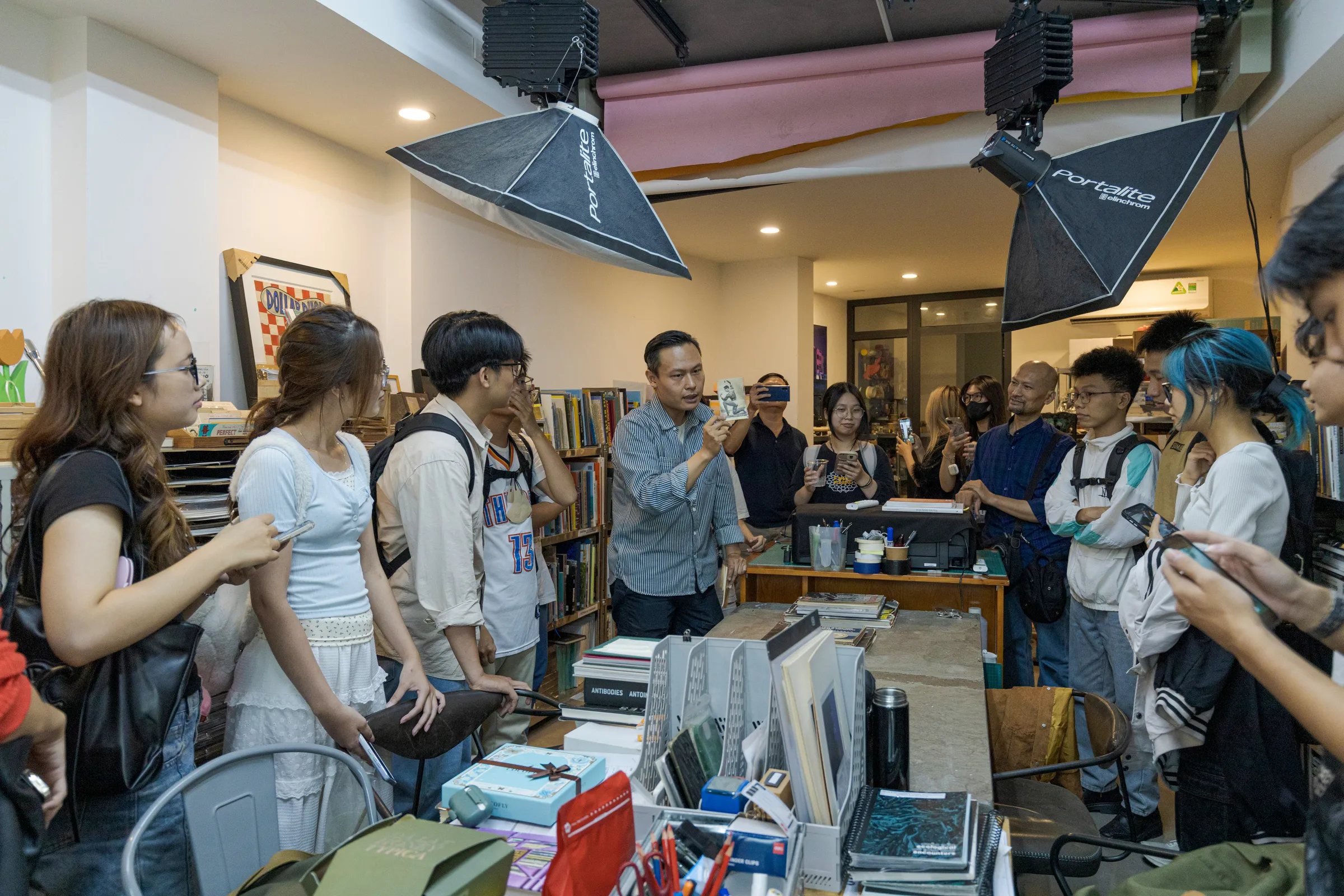
This year marks our tenth anniversary. Shouldn't this be a milestone, accompanied by a triumphant story, a moment to evaluate the successes achieved and chart the course for the future? The reality feels less ceremonial. There has never been a grand vision for Matca, and I also find it difficult to pinpoint a major turning point in our progress. Our platform was not founded to become unique or authoritative, nor to join the handful of cultural powerhouses that still exert a disproportionate influence on what the world values. Yet, within a 40m² space furnished with little more than the essentials, a wide range of encounters take place here.
Over the past year alone, we presented Angkor Hangover, a screening of 18 works from the 2026 edition of the Angkor Photo Workshops, one of the longest-running photography events in the region; Antoine d'Agata, who shared a video work in progress at Matca; Thy Phu, who stopped by to present a chapter of her research and donated ten copies of Warring Visions; Nguyễn Ngọc Hải, recipient of our Creation grant, showing an ongoing documentary project about his hometown in central Vietnam. Meanwhile, our own three-month mentorship programme, Roots & Worlds, shaped by new voices, themes, and concerns with each iteration, continues to evolve. These are all activities which emerged from a condition I have come to think of as the aforementioned Bergerian orphanhood.
Upon receiving a complex legacy without the means to decipher it, one has little choice but to actively seek out predecessors, find like-minded individuals, consolidate scattered materials, and establish provisional structures through which those fragments can be understood and shared. However, notwithstanding how grateful I am for our diverse network of collaborators, a close-knit community should not be the end goal. Solidarity is essential for survival, but the comfort of kinship also carries risks. If the camera functions as a window onto the world, highlighting differences rather than confirming what we already know, then a community must also remain porous, unbound by connectedness or consensus. It is at least my experience that such a notion of orphanhood can offer the freedom to foster connections without mistaking them for permanence.
Matca’s story does not lend itself to a linear growth narrative and our activities become most meaningful when reciprocity is linked to practical experiences: a photographer browses through our modest library and discovers a related predecessor; a conversation here shakes a long-held conviction; an image on the wall makes the familiar seem strange, or at least allows for multiple interpretations. Over the years, the website made local photography more widely accessible, and the “gallery” (for lack of a better word) allows conditions in which new photographic work can develop and find an audience, and this remains vital to us. If there is, in those activities, a guiding principle at all, then it is the confidence that something valuable can emerge from those continuous efforts, even if no concrete mission is achieved.
Over time, it has become increasingly apparent to me that making sense of the present is rarely served by straightforwardness. Earlier, I was describing strategic ambiguity: the practical softening of language adopted to navigate the conditions of visibility in Vietnam. This negotiation with institutional power is so that artworks can enter public life. But I am also invoking Édouard Glissant's "right to opacity," which stands almost in opposition to the task of translating, through appropriation, into the art world's lingua franca.7 To my understanding, it is about an ethical refusal of the demand that everything be rendered legible or fitting into dominant frameworks.
Staying opaque supports resisting the expectation that people, artworks, or cultures must become fully knowable in order to be valued. Perhaps, by detaching from the urge to rush toward discovering talent or correcting Western perceptions of Vietnam, we become better listeners to what remains unsaid. What kinds of images are missing? What language is (not) being used to speak about Vietnamese photography? Who gets to be recognised as a photographer in their own time? To map photography connected to the country in this way is not to establish a neat lineage or suggest a historical vacuum, but to better understand the conditions from which the present has emerged. All of this may sound abstract, yet I believe it is a way of staying rooted without claiming authority. The story of photography in Vietnam is still unfolding, and our role is to remain part of that process.


