

Paper Topples Rock
In the works of Ciara Richardson, the oscillation of feminine, cyclopean eyes flatten and crumple perpetually across ancient marble nudes. When these fragmented eyes assemble, paper topples rock.
When discussing the problematic nature of public colonial statues, Paul B. Preciado asserts that “statues fall for three reasons: decline, removal (from above), and toppling (from below)”.1 These reasons outline the shadows cast by the ideological structures du jour; lack of care, for example, of a public sculpture, (often feminine presenting) whose breasts are worn and discoloured from the excessive groping of tourists, to the performative and symbolic removal of former heads of state, often to indicate a new political era or to reflect renewed values of the general public.2
The third, a toppling from below, is often the final battlecry of the exasperated and the neglected. This toppling, most often a revolutionary act, is identified as a tactic of visual activism, most notably in the removal of slaver Edward Colston’s statue in Bristol 2020. According to theorist Nicholas Mirzoeff, “the statue was recovered from the sea and later displayed, still tagged with paint, horizontally in the M Shed gallery in Bristol”.3
This felled, supine position holds great significance in the dismantling of physical and ideological structural powers. Whereas in Colston’s case these structures were overtly rooted in racism and the capitalistic slave trade of the British Empire, similar ideological topplings can be observed across structural inequalities. These once “motionless avatars of domination” take on new meanings once toppled into horizontal submission.4 In this new state they are laid out like cadavers awaiting a cultural dissection.
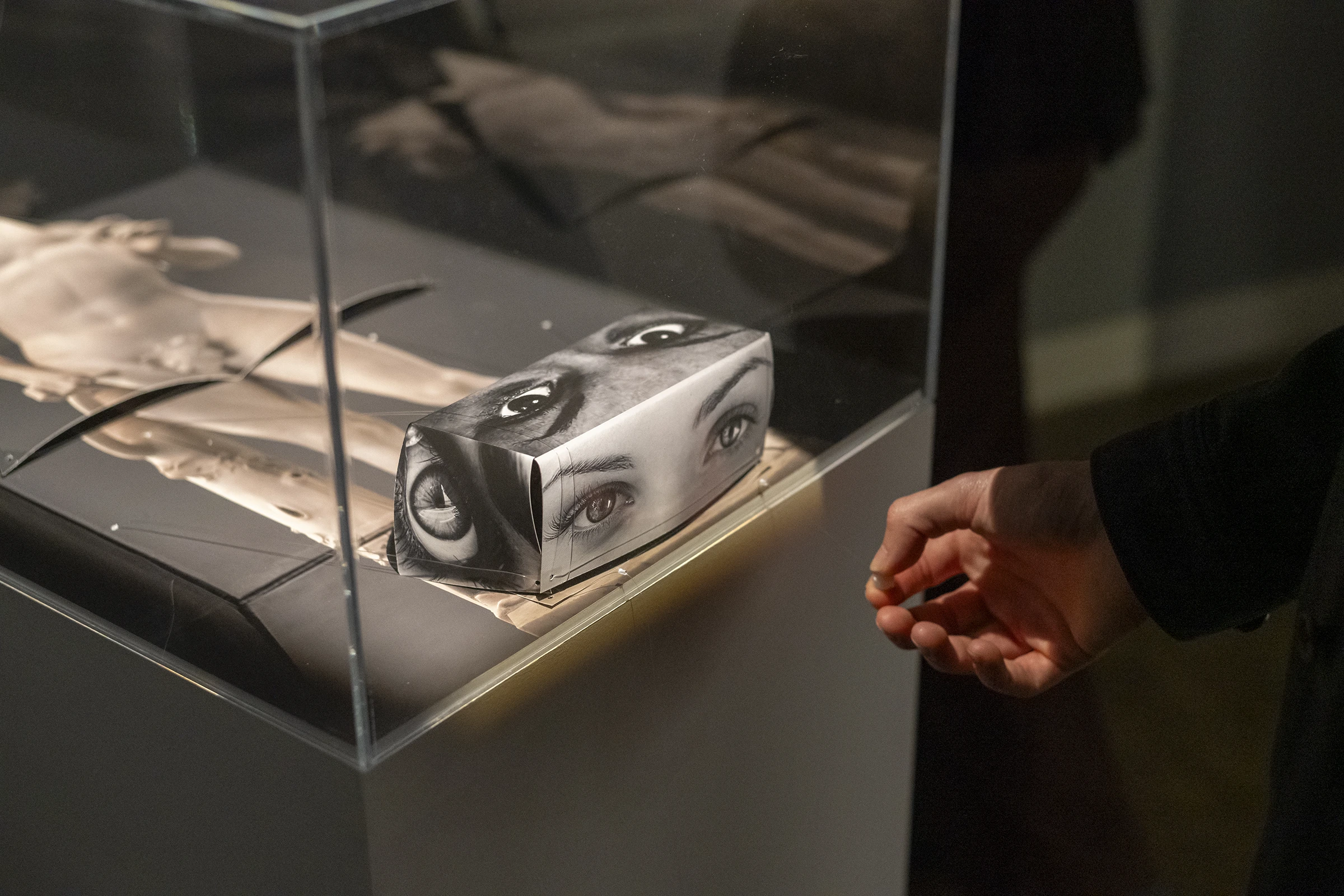
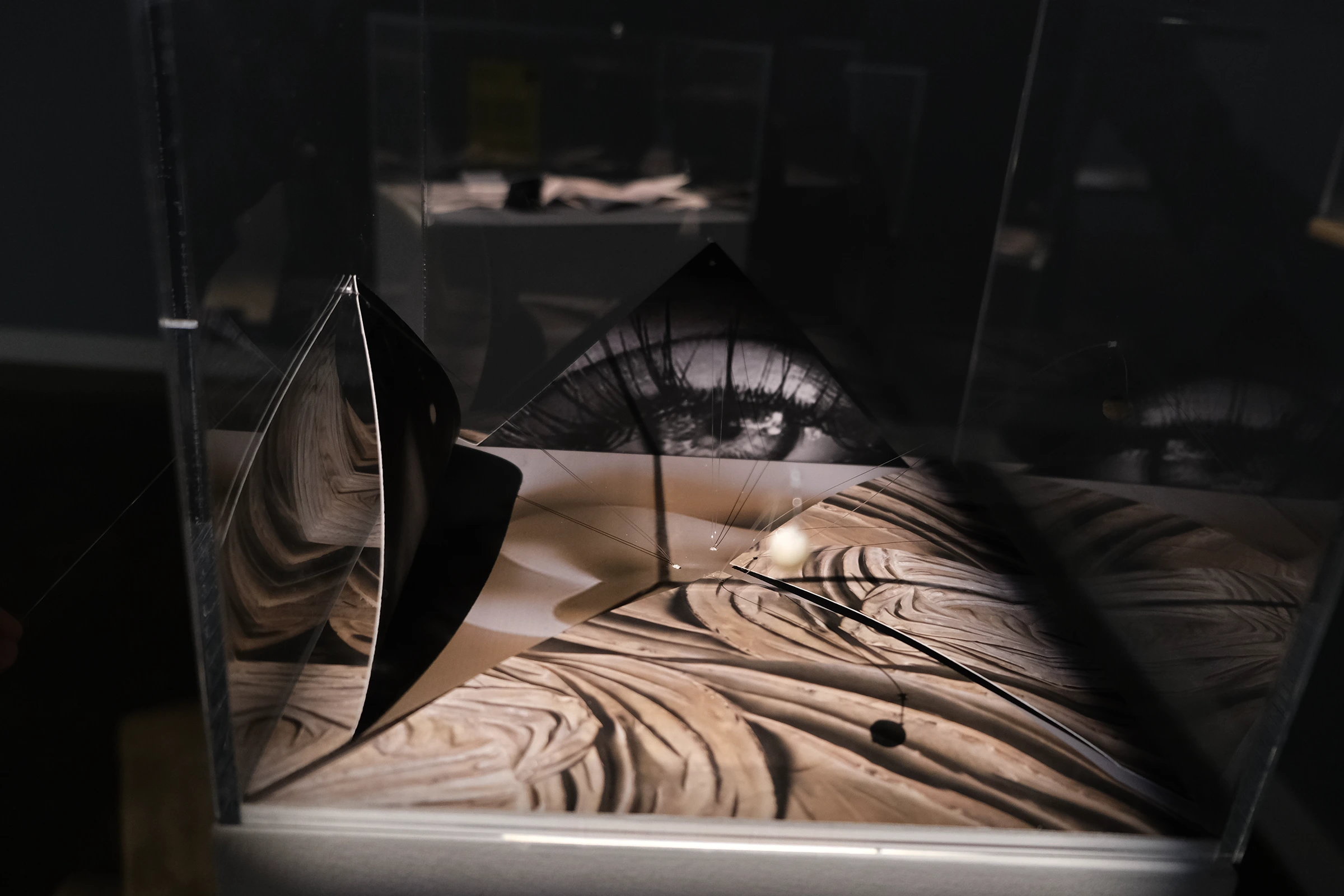
In Ciara Richardson’s How would you like it to happen to you?, well-known statues of both mythical and Biblical figures are reproduced and presented in a similar prostrate manner. Reduced to a flattened, two-dimensional object, these statues are deflated of their virility and masculinity. In gallery settings, the works are encased in clear vitrines, evoking pinned specimens and comatosed princesses, subverting John Berger’s pervasive refrain that “men act and women appear”.5 Furthermore, Richardson accepts the challenge posed by Berger later in his text:
“...the ‘ideal’ spectator is always assumed to be male and the image of the woman is designed to flatter him. If you have any doubt that this is so, make the following experiment. Choose from this book an image of a traditional nude. Transform the woman into a man. Either in your mind’s eye or by drawing on the reproduction. Then notice the violence which that transformation does. Not to the image, but to the assumptions of a likely viewer”.6
While this experiment may not translate seamlessly onto Richardson’s statues, the invitation remains the same. Richardson’s act draws attention to us as viewers to consider the norm and its absurdity. Their techniques in doing so are layered, pointing to multiple structures of dominance and power, each one toppled by the respective methodologies employed in the series.
Like Berger’s edict, Filmmaker Nina Menkes speaks to a similar axis of viewership within cinema.7 As part of the visual structures identified by Menkes, the framing of women holds great significance in that they are often “shot with fragmented body parts”.8 It is precisely this fragmentation that is utilised and subverted in Richardson’s statue works, the genesis of which also looks to cinema history.9
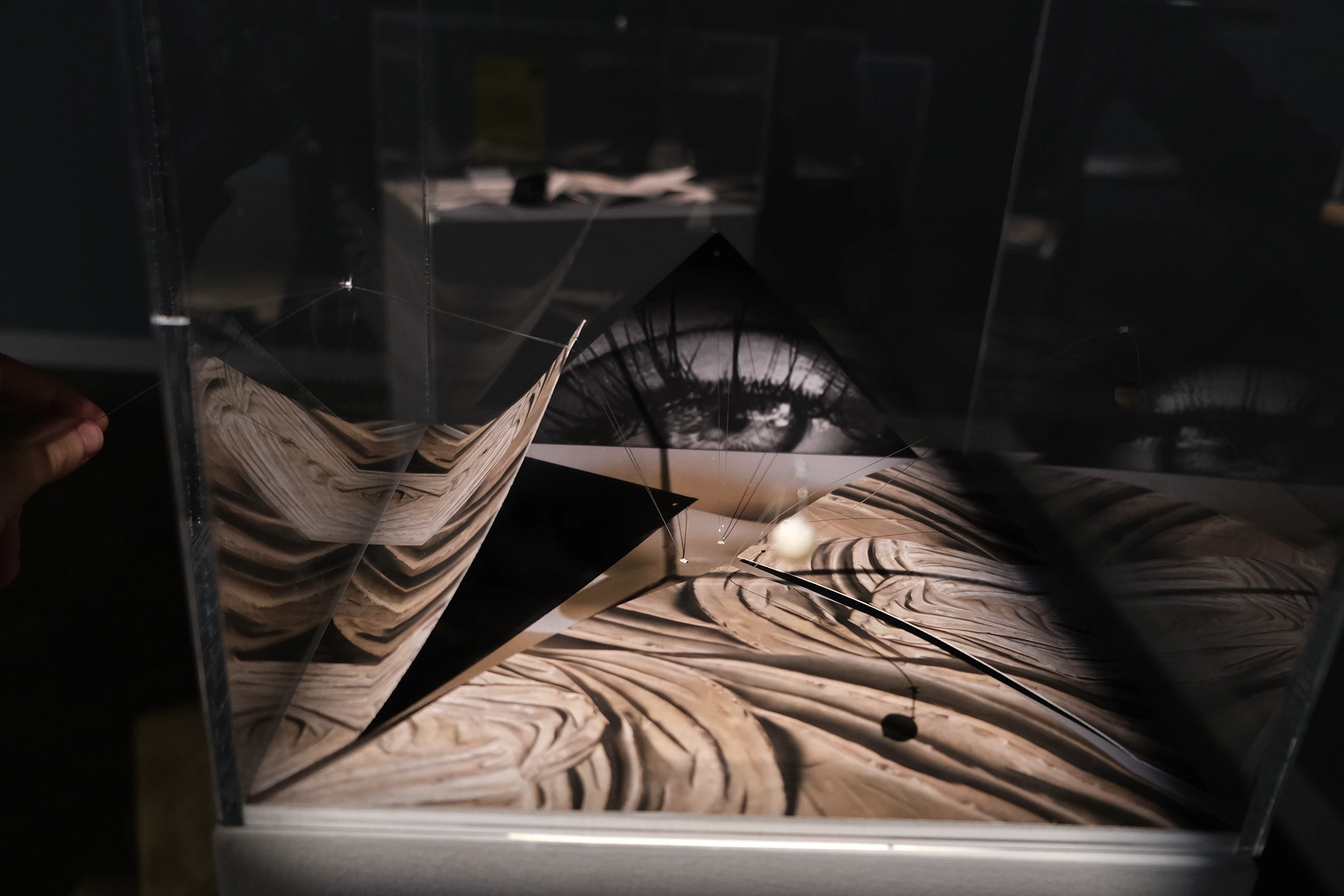
In these works, Berger's earlier warning of a violent transformation is further complicated by the introduction—or reintroduction—of sculptural dimensions. A series of levers, pulleys and weights activate an exaggerated gesture that echoes the movement of Marilyn Monroe’s billowing white dress. In yet another subversion of form, this gesture is transposed to Michaelangelo’s David and Polykleitos’ Hermes, transforming the works from flattened, toppled dormancy to a battlefield of prisms, cylinders and cubes, each polygon populated by the fragmented gaze of feminine eyes.
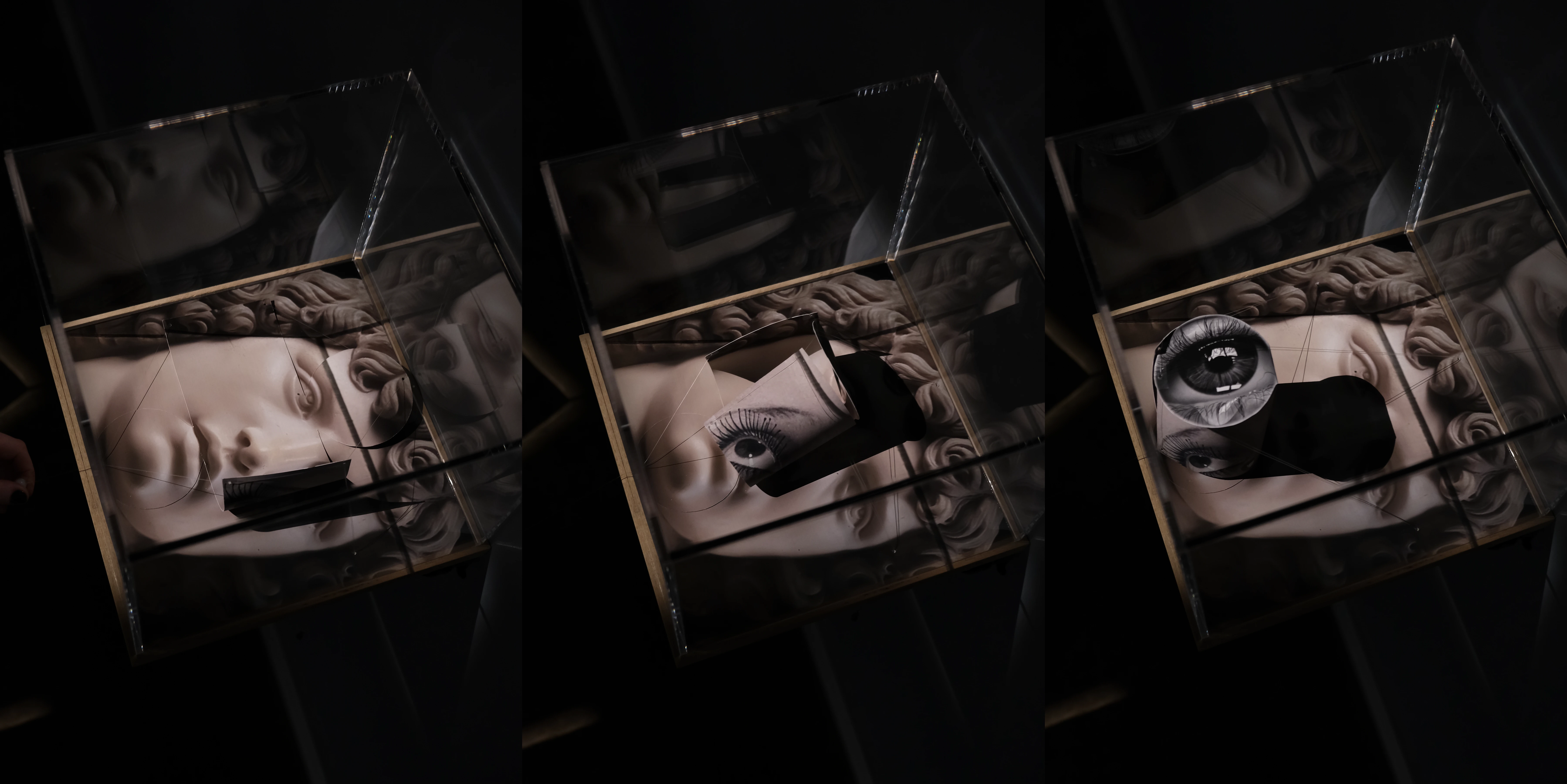
For these contractions and manipulations to work, the images themselves must be laid horizontally; statues toppled and flattened only to be ‘built upon’ once more. This movement exists in a series of subversions, functioning in unison to question and challenge the gender binary. Queer theorist and photographer Äsa Johannesson, identifying her own work as “exist[ing] outside of flatness and rectangularity”, notes that “further subversion occurs in its relation to medium specificity” when the status of a photograph is questioned once it has transformed into a sculpture.10 Richardson's work undergoes similar challenges to the binary—part sculpture, part collage, part photograph and, at times, animation—existing in a liminal yet hybrid space. One must consider materiality in addition to medium. Its significance in this instance lies beyond photography’s typical relationship to paper, functioning instead as a tool of architecture and design: how our world is shaped and constructed.
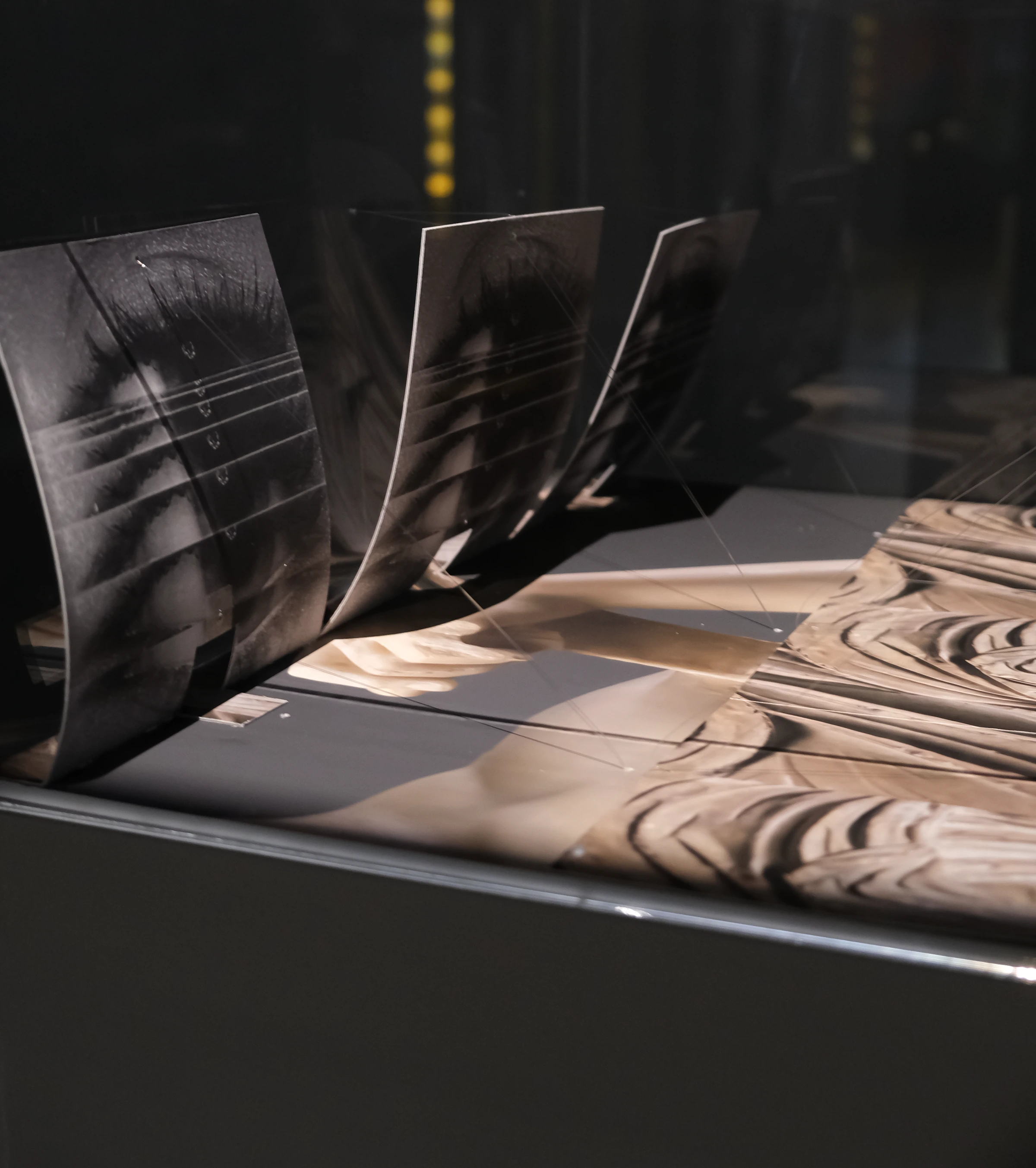
The paper folds now resembling maps; floorplans, battleplans, and blueprint, while the fragmented, cycloptic eyes that form pyramids now connote dollar bills, inevitably returning to indicators of surveillance and power. And yet there is playfulness at the heart of these works, objects that invite interaction and collaboration. Richardson encourages play through the work with the invitation of childlike curiosity with the implementation of inquiry, reward and repetition. The choppy movements echo the conventions of stop-motion, particularly the absurdist cut-out creations of Terry Gilliam, an animator who frequently engaged with fragmented relics of antiquity, often to violent ends.11 One thinks also of collapsible push puppets, childhood statuette toys that contort and reform with the push of a thumb. Once more, these actions speak to a subversion of the gender binary. Not forwards in post-binary thinking necessarily, but instead to childhood and states of pre-sexualised gender roles and performativity.
By returning to the question of materiality, further connections of play are revealed,12 literally and linguistically, when the work is perceived in its chronological iterations. These childhood games echo an endless tug-of-war with the repetitive ideological struggles of gendered power.
The present feature is part of a series of articles across print and online reflecting on the 10 artists participating in the New Irish Works programme. New Irish Works is a triennial set of activities launched in 2013 by PhotoIreland to support photographers and the accompanying exhibition runs until 9th August 2026 at the International Centre for the Image, Dublin. See image.museum for more details.
1 4 Paul B. Preciado, “WHEN STATUES FALL,” Artforum, December 1, 2020, [URL] [Date Accessed: 27.04.2026]
2 Tim O’Brien, “Flower-Bed Barriers to Be Placed around Molly Malone Statue to Discourage Tourists from Touching Breasts,” The Irish Times, July 22, 2025, [URL] [Date Accessed: 28.04.2026]
3 This historic act of public catharsis occurred in the wake of anti-racism protests across the globe. Bound and graffitied, Colston’s statue was rolled and dragged through the city’s streets before finally being deposited in Bristol harbour.# Later, this felled effigy found its place in the local people’s museum- encased and horizontal. Nicholas Mirzoeff, “Removal,” in An Introduction to Visual Culture (Taylor & Francis, 2023), p.161.
5 6 John Berger, Ways of Seeing, 9th ed. (1972; repr., Penguin Books, 1990), p.47 and p.64.
7 In her documentary Brainwashed: Sex - Camera - Power; noting a “standard line of identification” tailored to reinforce a cisgender heteronormative viewpoint. Nina Menkes, Brainwashed: Sex - Camera - Power (Kino Lorber, 2022), [00:23:47].
8 Menkes, Brainwashed, [00:12:33].
9 Ciara Richardson, “How Would You like It to Happen to You? | Mysite,” mysite, 2019, [URL]
10 Äsa Johannesson, “Ground: On the Margins of Photography ,” in Queer Methodology for Photography (Routledge, 2024), p.109.
11 BBC Archive, “1974: TERRY GILLIAM on CUTOUT ANIMATION | the DIY Film Animation Show | Classic Clips | BBC Archive,” YouTube, March 25, 2022, [URL]