





The Image as System
An image is no longer certain. It has ceased to function as index, evidence, or representation in any stable sense. Increasingly, images are generated not for human comprehension, but for machine processing—composed through models, optimised for circulation, and rendered for systems that sort, predict, and extract. They move through pipelines and platforms, accumulating legibility without necessarily producing meaning. They are not read—they are routed. And they are evaluated not by what they show, but by what they allow: what they let pass, what they keep in motion, what they smooth over. To ask what an image is today is to ask how it behaves—how it circulates, performs, and operates across technical infrastructures and within affective economies. If images once claimed to reflect the world, today they compose it. They orchestrate attention, administer emotion, and encode permissions. They choreograph not only what is seen, but what is possible to feel, to say, to become. They do not represent power— they perform it. The image is now a system: dynamic, composite, and procedural. It calibrates perception to match the needs of platforms, classifiers, and metrics. And in doing so, it no longer mediates—it governs.
This is more than a transformation in visual culture; it marks a reorganisation of political space, and with it, the social relations it encodes. Images today do not produce meaning to be interpreted; they produce coherence to be operational. They are central to how platforms administer presence, how content is valorised, how participation is rendered as performance. Under these conditions, visuality becomes a form of administration: distributed through soft design, frictionless interaction, algorithmic sorting, and the aesthetic management of contradiction. What we call “an image” is often just the visible surface of a deeper infrastructure, an interface designed to align subjects to systems without their consent. In what follows, I approach the image as infrastructure, tracing how it formats visibility, flattens antagonism, and encodes relations as transactions. The question is not what an image shows, but what kind of social, emotional, and computational world it helps to construct. This requires a shift in how critique is practiced. Not toward negation or retreat, but toward a closer reading of operational form: how the image performs, what it permits, and how its procedures might be misaligned, corrupted, or redirected.
If an image is no longer just a surface to be looked at, but a signal to be processed, then Simone C. Niquille’s duckrabbit.tv (2023) operates entirely within this logic. Rather than critiquing computational vision from the outside, it is constructed from within, built through rendering engines, calibration tools, classification systems, and predictive algorithms. These are images composed through “seeing” by other means: through sensors, datasets, networks, and the visual memories of machines. duckrabbit.tv traces how images are increasingly formed not for human eyes, but for systems, trained on mappings, simulations, and anticipations. Navigating this infrastructure, Niquille exposes how contemporary images no longer depict the world, they precondition it. They are not representations, but operations: choreographies of light, data, and control that act across bodies, memories, and space.
Structured as a speculative TV series about a queer character navigating a computational terrain, duckrabbit.tv doesn’t tell a story in the traditional sense. It is a composited world made from CGI fragments, aesthetic references, optical tricks, and rendering debris. A world where everything is synthesised, and nothing is stable. duckrabbit, a character drawn from Joseph Jastrow’s 1892 optical illusion, later re-popularised by Wittgenstein, appears across seven short videos in endless variation: balloon, shadow, cartoon, chrome, traffic sign, bunny, duck, meme. It never settles. This isn’t about identity play or confusion. It’s about refusing to stabilise into the kinds of legibility demanded by computational systems, systems that do not interpret, but sort.
From its opening moments, duckrabbit.tv makes clear that the image it offers is not for contemplation but for circulation. duckrabbit—equal parts cartoon and calibration object—is built within the aesthetic language of children’s media and CGI. But its behaviour reveals something else: this is an image constructed within the logic of computational vision. It does not ask to be understood; it asks to be processed. It is formatted, animated, sorted. Drawing on systems designed to detect, predict, and classify, duckrabbit becomes a means of exposing the architectures that produce legibility itself. These architectures, originally developed for military target recognition and now embedded in everyday apps and interfaces, render visibility as a form of control. As Trevor Paglen and Kate Crawford argue, machine vision systems are “not just seeing machines,” but “weapons of epistemic control.”1 They do not merely capture images but organise knowledge—encoding assumptions about what is real, what is threatening, what should be ignored. Their function is to optimise and align perception with institutional priorities in law enforcement, content moderation, logistics, and finance. Crucially, they rely on anticipation rather than accuracy. duckrabbit exists within this logic: passing just enough to circulate, but never enough to become usable. It reveals how the violence of classification lies not in error, but in the functionality of visibility itself.
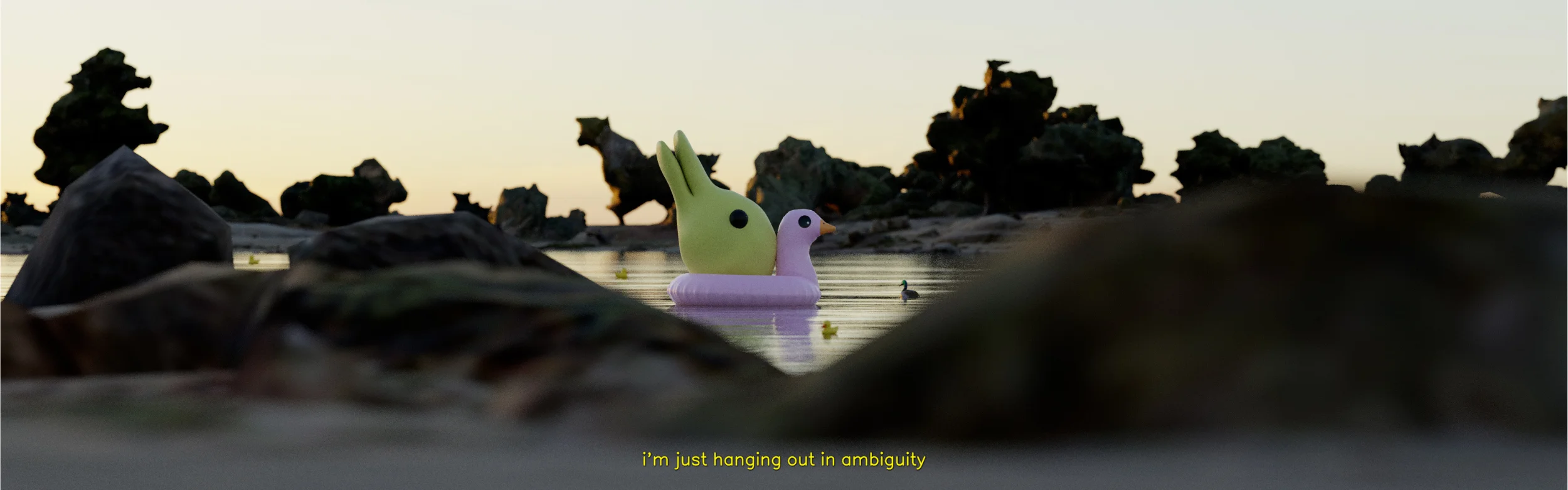
This violence is rendered soft. duckrabbit.tv never announces its critique, it performs it through cuteness. duckrabbit is rounded, colourful, and expressive, drawing on the visual vocabulary of cartoons and memes. But as Sianne Ngai reminds us, cuteness is not innocent. It is a mode of affective governance: “aesthetic power disguised as passivity.”2 It invites attachment while soliciting control. duckrabbit looks harmless, even lovable, but it operates within and through the same systems that underpin surveillance, biometric sorting, and predictive modelling. Its disarming effect is part of the structure. What duckrabbit.tv makes clear is that images today do not need to convince, they need to pass. And duckrabbit passes by performing recognisability just well enough to be processed. As Jacob Gaboury writes, contemporary visuality is shaped not by representations, but by “image-objects”3 composites that function as signals in computational workflows. They are evaluated not by meaning, but by how well they conform to expectation. duckrabbit is exactly such an object: born from, and circulating within, the very systems it stages.
Each video enacts a different facet of this circulation. In one, duckrabbit appears as a chrome balloon, an HDRI calibration sphere, used not for vision but for simulating light. In another, its shadow misaligns within a Cornell Box, revealing a simulation that doesn’t fail, but quietly misbehaves. duckrabbit is stretched across a planetary geoid model, its body becoming a signal dragged across an unstable geometry. It’s reoriented 90 degrees at regular intervals, severing any fixed relation between camera and subject. It replicates as Psyduck, Oswald, Donald, and banana duck—image-forms that multiply without origin, flooding recognisability with redundancy. In a final loop, duckrabbit races between the “Big Duck” building and a minimalist shed marked “don’t assume”. It doesn’t choose between message or metaphor. It animates both.
These fragments don’t disrupt the system by breaking it, they mirror its logic with eerie precision. They render just enough coherence to pass, just enough noise to resist absorption. duckrabbit becomes an image optimised for circulation, but empty of compliance. It is legible without understanding, affective without relation, structured without consequence. It shows us what an image becomes when it no longer represents, but simply performs, barely seen, perfectly formatted, always already behaving. This is where duckrabbit.tv leaves us: inside a regime of images that no longer interpret the world but organise it. These are not representations, but operations, generated to choreograph behaviour and reproduce existing structures of power. They do not invite looking but administer presence. They determine what is permitted to appear, and in doing so, strip away instability, friction, or refusal. If the image today is both infrastructure and interface, then the work of reading it must move beyond critique and into confrontation, with the systems that compose it, and the realities they quietly sustain. What duckrabbit.tv lays bare is not just an aesthetic condition, but a structural one. Images today are no longer composed to reflect reality, they are engineered to govern perception. They emerge from technical infrastructures optimised for prediction, legibility, and control. In systems such as facial recognition for law enforcement or algorithmic screening in immigration and visa processes, images don’t just show identity; they assign risk, automate suspicion, and determine access. These are not representations, but operations, generated to choreograph behaviour and reproduce existing structures of power. These are not passive pictures, but active instruments, formatted for compliance, calibrated to operate within regimes of coherence. They do not depict systems of power; they are those systems, rendered visible only when something slips. To understand the image now is to confront its logistical, procedural, and affective functions, not what it represents, but what it demands, enforces, and sustains.
The politics of the image today cannot be read through content alone, but must be understood through its formatting, its workflows, and the kinds of relations it permits or forecloses. The question is no longer what an image means, but what kind of world it assumes and sustains. Niquille’s work doesn’t answer this—it enacts it. It sabotages the image’s usefulness by remaining recognisable but noncompliant, circulating without ever serving. It exposes the quiet violence of computational vision, not by breaking it, but by letting it operate to the point of absurdity. The image, here, is not a window or a record. It is a system—visible only when it misbehaves. Where Niquille reveals how images are trained—composed through calibration, classification, and aesthetic smoothing, Uncensored Lilac (2024) shows what it feels like to live within that compositional regime. The image no longer mediates relation; it replaces it. What remains is visibility without reciprocity, expression without connection. Bassam Issa Al-Sabah and Jennifer Mehigan stage this affective consequence: a world in which every figure is hyper-readable, but structurally alone. Their goddesses do not scramble the system—they perform within it. Endlessly expressive, emotionally vivid, and dissonantly beautiful, they embody what happens when presence is maintained not through coherence or dialogue, but through image-performance designed for circulation. The result is not breakdown, but saturation. Not opacity, but too much legibility. The image doesn’t fail, it circulates, endlessly, without friction.
Uncensored Lilac, a film and installation by Bassam Issa Al-Sabah and Jennifer Mehigan, unfolds in a heat-struck, emotionally saturated landscape inhabited by a group of goddesses and their entourage of avatars, animals, and synthetic companions. Commissioned as part of an ongoing curatorial inquiry into image-performance and affective fragmentation, the work constructs a post-communicative world, one in which infrastructure still holds, but relation does not. The characters exist in the same landscape but share no common ground. They speak only to the camera, performing monologues of desire, boredom, rage, and contradiction. There is no plot, no collective arc, no dialogue. What binds the work is not narrative, but address. Each figure appears as a node in a system of fractured visibility: expressive, aestheticised, and fundamentally alone.

The film unfolds in a synthetic, dreamlike terrain where climate collapse has destroyed not only the environment but the very conditions of social relations. Heat is everywhere—both environmental and emotional—but it does not bind these figures together. Instead, it mirrors the affective atmosphere of platform culture: everything is oversaturated, overexposed, and over-expressed. The goddesses are beautiful, highly aestheticised, glitchy and veiny, adorned with pearls, flowers, and monumental forms. Their bodies shimmer under pressure, but they never break. They become avatars for a particular condition of life under digital capitalism: hyper-visible, emotionally available, and structurally isolated. The image here functions not as representation, but as fractured performance, a form that centres visibility, disconnection, and address without response. In this world, the image is a surface for expression, not a site of relation. It does not mediate between figures or build shared ground. Instead, it sustains presence. Each goddess performs for the camera, for the screen, for us, expressing but not listening, declaring but not responding. This performance is not a breakdown of the system; it is the system. The film offers no outside to the infrastructure of visibility. The goddesses do not resist it. They embody it fully.
This condition, where visibility is decoupled from relation and saturated with performance, is not confined to fictional worlds. We live inside similar dynamics every day. When Kim Kardashian appears in a Paris courtroom wearing €1.5 million in jewellery, and on the same day, headlines announce her role in a Ryan Reynolds legal drama, it is not a coincidence. These events, though distinct in tone and setting, are networked images: distributed nodes in a system designed to maintain and extend her image across different registers of visibility. Each appearance does something different—legal credibility, glamour, star power—but together, they stabilise the persona. They form what Keller Easterling might describe as an image infrastructure: not a singular expression, but a set of soft, synchronised performances that reinforce presence through accumulation. As Easterling writes, “infrastructure is not the hidden, buried, or mechanical, but the information that orchestrates how things happen.”4 These orchestrations don’t require control at every node; they rely on patterns, defaults, and choreographies of coherence.
This is what Uncensored Lilac makes visible, not through realism, but through saturation, contradiction, and aesthetic overload. The goddesses in the film are not coordinating anything, yet they operate in the same system: one in which image is performance, visibility is currency, and no shared ground is required. They are each constructing a presence through expression, style, contradiction, and indifference to others. This is how infrastructure works in visual culture today, not through a central message, but through dispositional coherence across affective performances. The image must remain legible across fragmentation, beautiful across collapse, and visible across disconnection. What Uncensored Lilac captures is not the failure of communication, but its redesign under the conditions of distraction. There is speech, but no dialogue. Expression, but no relation. Each goddess addresses the viewer, not each other, rehearsing the loop of public monologue that defines so much of online life. The image is not a site of exchange, it is a system for sustaining presence. Al-Sabah and Mehigan do not break this system; they hold it up and let it speak. The result is not a critique from outside, but an inhabitation of the infrastructure itself: fractured, glamorous, overheating, and perfectly operational. In this way, Uncensored Lilac does not seek to repair the image or return it to a prior function. It stages what the image already is: a fractured performance sustained by platforms, emotionally legible but relationally empty. It asks what happens when visibility becomes the only common ground, and when even that is saturated to the point of collapse. If the image today is not a representation but an infrastructure for distraction, then the figures in Uncensored Lilac do not merely perform within it. They become its clearest expression.
What Uncensored Lilac ultimately stages is the afterlife of the representational image, what remains when images no longer depict but perform. Here, the image is no longer anchored to reference or meaning, but to mood, tone, and coherence. Expression becomes ambient. Communication becomes aesthetic. Presence is sustained not through interaction, but through repetition and visibility. The result is not rupture, but smooth fragmentation: a world held together by performance alone. This is the image under platform conditions, not fractured in form, but in function. It doesn’t disappear. It circulates. It accumulates. And in doing so, it governs and regulates how we appear within it. Uncensored Lilac doesn’t mourn this shift. It renders it without relief. In doing so, it makes visible a new logic of the visual, one defined not by representation or recognition, but by affective saturation and the infrastructural choreography of attention.

What kinds of images remain possible under conditions of saturation, optimisation, and soft control? How can visual practices intervene in systems that no longer represent but operate, systems that govern affect, coherence, and attention? Is it still possible to produce images that don’t reinforce existing infrastructures, but disorient them? Ayoung Kim’s work takes up these questions by exploring how images might be composed differently, not to confirm meaning, but to destabilise it. Rather than withdrawing from the systems that govern seeing, she works from inside them, misusing their logics to produce visual and narrative configurations that resist capture, coherence, and prediction. Her practice bends the technical and affective protocols of image-making: scrambling genre, rupturing linearity, and rendering synthetic worlds that don’t stabilise. In Delivery Dancer’s Arc: Inverse (2024), Kim opens up the question of what else images could do, how they might displace the present by fabricating new perceptual grammars.
Ayoung Kim’s Delivery Dancer’s Arc: Inverse explores how algorithmic systems extend older colonial mechanisms of epistemic control—substituting cultural multiplicity with speculative futures drawn from homogenised, Western-centric datasets. The film unfolds in a synthetic world shaped by logistical abstraction and climate collapse, where characters, human and synthetic, navigate a landscape of loops, delays, and stalled routines. Kim constructs a speculative world that operates not through narrative progression, but through procedural drift. Set in a high-rise arcology built from glass, fog, and data, its environments are assembled from the textures of logistics, climate collapse, and ambient computation: a speculative arcology in which food delivery systems, remote labour, and ecological exhaustion fold into each other without resolution. Time does not move forward, it loops, glitches, resets. A delivery dancer traverses rendered terrains in choreographies that seem part exercise routine, part courier route, part survival ritual. Along the way, she passes empty lobbies, service corridors, and synthetic landscapes rendered in flat palettes, echoes of a world both post-human and post-relational. She is always moving, but never arriving. As the film loops, time becomes elastic, bent into feedback cycles where arrival is endlessly deferred.
This is not a vision of a distant future, but a warped continuity of the present. The speculative quality of Delivery Dancer’s Arc: Inverse lies not in its departure from reality, but in its recomposition of it, stretched, duplicated, and reformatted through the soft interfaces of synthetic seeing. Kim’s world is not utopic or dystopic. It is procedural: structured by optimisation, designed to appear seamless, yet always slightly out of sync. Corporate voice overs echo logistical systems and institutional rhetoric. Avatars glitch between identities. Bureaucratic calm overlays climate panic. The image appears functional, but something slips.
Visually, Delivery Dancer’s Arc: Inverse, mimics the grammar of simulation: volumetric fog, clean interfaces, hyper-stylised avatars. It pulls from the aesthetic libraries of games, speculative architecture, and algorithmic media. But this polish is deceptive. Beneath its surface, the work operates as a misalignment engine, rendering a world that adheres to the visual conventions of control while eroding the stability they promise. The speculative here is infrastructural: not just imagined futures, but the breakdown of the logics we already live within, automated planning, procedural design, and the ambient governance of platforms.
Rather than build a counter-narrative, Kim builds counter-infrastructures of vision. Delivery Dancer’s Arc: Inverse doesn't ask to be interpreted; it asks to be navigated. It redirects our attention away from content and toward behaviour: how images loop, how interfaces persuade, how affect circulates in closed systems. This is a visual system trained on feedback, noise, and non-events. It mimics coherence but offers no resolution. And it’s precisely in this drift—this soft collapse of function—that Kim opens a space for other perceptual arrangements to emerge.
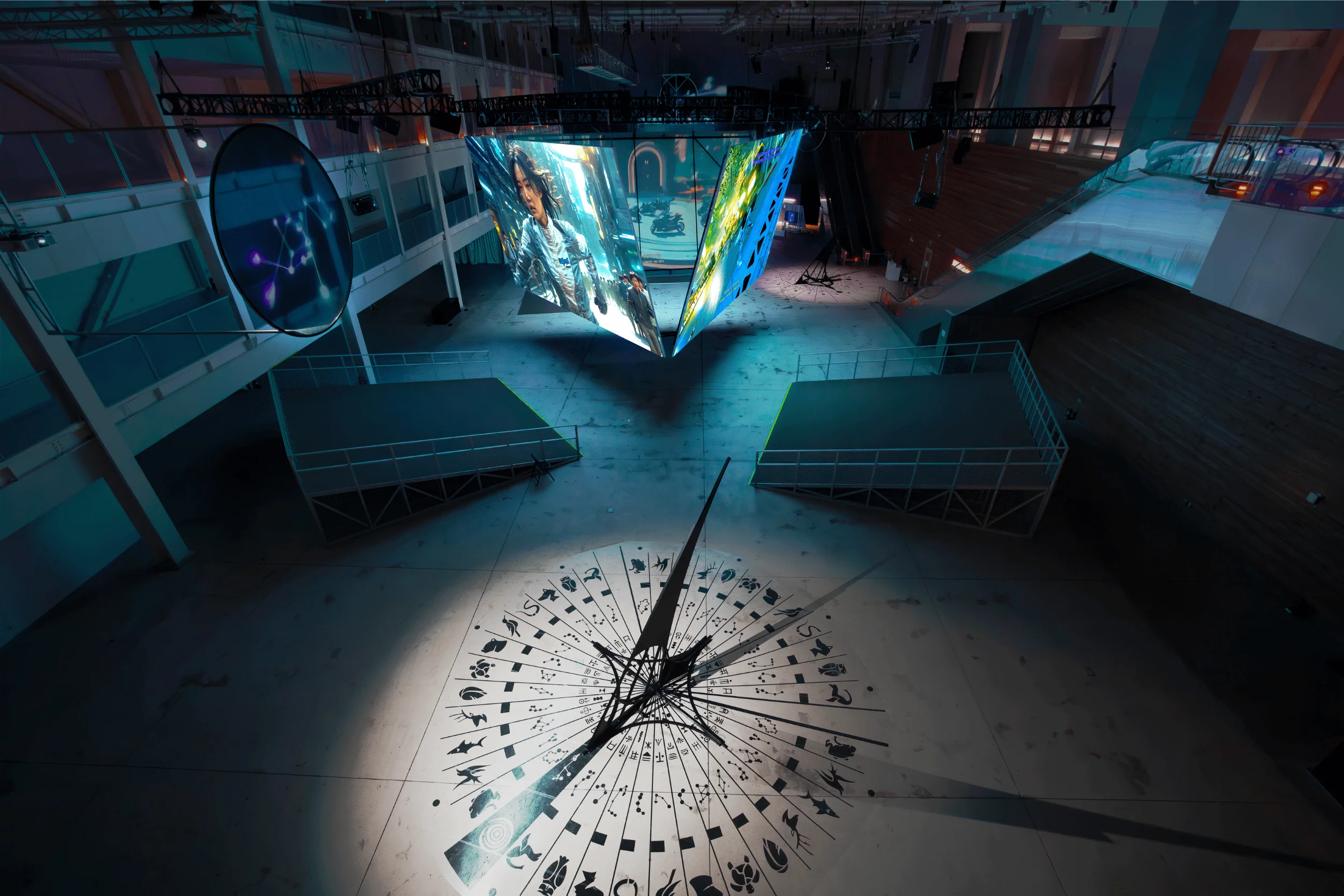
Delivery Dancer’s Arc: Inverse doesn’t critique from outside. It renders from within. Its counter-image is not oppositional in form, but operational in logic; a misused simulation, a softened breakdown. What Kim offers is not an alternative vision, but an alternative use of vision itself: one that embraces the infrastructural aesthetics of control only to show their internal incoherence. She does not dismantle the system. She lets it run until its procedural logic begins to produce dissonance.
What Delivery Dancer’s Arc: Inverse ultimately exposes is not just the aesthetics of infrastructural control, but its exhaustion, how seamlessness wears thin, and how friction resurfaces in the affective debris of the system. Kim reframes the image not as a container of meaning, but as a structure of behaviour: something that governs through loops, moods, and feedback rather than through representation. Her work offers no redemption, no catharsis, but it does propose a different relation to the image, one that treats vision not as revelation, but as orchestration; not as content, but as choreography. This is not a return to the image as index or document, but a reorientation toward its operational patterns. The work doesn’t ask what we see, but what we’re trained to recognise. It stages what it means to live under images that no longer represent us but perform us. In this way, Delivery Dancer’s Arc: Inverse prepares us for a broader shift: from the image as expression to the image as environment. It doesn’t merely render a speculative world, it implicates us in the one we already inhabit. In turning the image into an environment, Kim brings us to the edge of a broader condition—one shared, in different registers, by all three practices.
Across these three practices, the image no longer appears as a stable surface or representational object. It emerges as an infrastructure: something formatted, circulated, and performed. Whether through the computational legibility of duckrabbit.tv, the saturated performances of Uncensored Lilac, or the speculative misalignments of Delivery Dancer’s Arc: Inverse’ the image reveals itself not as something to be interpreted, but something to be navigated. It behaves. It routes. It governs. What aligns these practices is their engagement with the image as infrastructure, each staging its conditions of production, circulation, and affective use. They do not offer icons or answers. They offer systems—constructed, mimicked, inhabited. And in doing so, they expose how images today act as techniques of coherence: smoothing contradiction, organising perception, and scripting relation. But within each practice, something slips. The surface fails to hold. The performance frays. And in that moment, the image stops confirming the world and starts interfering with it.
These are not merely shifts in aesthetics or technique, they are shifts in power. When images operate as infrastructures, they do more than represent, they manage. They determine what kinds of bodies become visible, what kinds of speech appear plausible, what kinds of futures seem actionable. What is at stake is not just how we see, but how we are governed: affectively, procedurally, and perceptually. The works discussed here don’t seek to restore the image’s former role as evidence or expression. Instead, they ask what it means to act when every appearance is already administered, when the visual itself has become a site of compliance. In response, these works do not offer alternatives outside the system; they offer modes of misalignment within it. They use the aesthetics of platform legibility, procedural coherence, and computational polish not to confirm these systems, but to push them toward instability. Their power lies not in withdrawal, but in strategic misbehaviour: performing just enough to pass, but never enough to serve. In this, they model a politics of interference, one that does not aim to dismantle the infrastructure of the image, but to misalign its logics from within. This is not about critique as content. It’s about critique as composition. As navigation. As misuse. These are not images designed to reveal truth. They are designed to complicate sense, to reroute attention, and to animate the exhaustion of systems that no longer need to be seen to function. If the image once mediated between self and world, these works show us what happens when it becomes the very architecture through which both are constructed.
1 Crawford, Kate, and Trevor Paglen. “Excavating AI: The Politics of Images in Machine Learning Training Sets”. Excavating AI, 2019. Link ↗
2 Ngai, Sianne. Our Aesthetic Categories: Zany, Cute, Interesting. Cambridge, MA: Harvard University Press, 2012.
3 Gaboury, Jacob. Image Objects: An Archaeology of Computer Graphics. Cambridge, MA: MIT Press, 2021.
4 Easterling, Keller. Extrastatecraft: The Power of Infrastructure Space. London: Verso, 2014.


